


In post-war America, a dream of a new way of spending time together was born. The A-frame cabin became symbolic of the new mobility of the middle class, and of their vision of owning vacation homes of their own. After spending twenty years out of the public imagination, this style is set to make a comeback.
Words by Jonas Henningsson
Just imagine: A building constructed as a perfect equilateral triangle. Or, if you prefer: A building shaped like the letter A. A as in ‘All you could dream of for yourself and for your family.’ A as in ‘All you want is to spend time with your loved ones.’ Or, A as in ‘All you’ve ever dreamed of is winding down, disconnecting, and recharging.’ Somewhere far from your real home, and from all the chores of everyday life. Far from convention, and duty, commitments, or troubles. A as in Adventure, and Attitude. A as in Awesome. A as in A-frame.

– “I think it’s mainly a matter of the contrast between the promise of the A-frame and people’s everyday experiences. It’s all about simplicity, light, warmth, and proximity to nature.”
Hjalmar Hedman tries to put into words what it is that makes him so fond of this style.
He is a Swede, and he grew up in the north of Sweden. He moved to the US in 2005, living in Los Angeles at first, but then, a few years ago, he relocated to the mountains of Utah. In Park City, his family, which includes himself, his wife, and their two children of 3 and 1, lives in a more ‘contemporary’ A-frame (apparently, he can’t resist spending his everyday life in one of these buildings, -either). They spend their free time in the mountains, both in the summer and in the winter. When they were looking for a weekend cabin, they only ever considered one shape: the A.
– Our A-frame is in the mountain, in Big Bear, California, just a few hours east of LA. Big Bear is a stark contrast to LA, with its mountains, lakes, and woodlands. You can ski in the winter, and cycle and hike in the mountains in the summer, Hjalmar explains.
History: The Rise and Fall
In the 50s and 60s, the A-frame cabin was the most cherished of American vacation dreams. Over a few decades, hobbyists and family men constructed tens of thousands of A-frames. Recreational and weekend trips were associated with exploring lakes, forests, and mountains, and the A-frame cabin was the perfect fit for these new favorite pastimes.
The most important predecessors of the post-war era A-frames were the vacation homes that Rudolf Schindler designed and built in the 20s and 30s. From his South California base, Schindler, who was also a protégé of Frank Lloyd Wright, spread his modernist architecture, which also incorporated contemporary materials. Way back in 1936, Schindler was asked to make the blueprints for Gisela Bennati’s cabin on a hill overlooking Lake Arrowhead in California. The Homeowners’ Association required all new buildings to be constructed in to the Norman style, but Schindler managed to meet this require-ment by going back to an ancient shape.

A full twenty years before the A-frame truly hit the mainstream, Schindler was already using plywood and other modern materials, bringing the roof all the way down to the ground, and finding a spacious solution with the characteristic high loft. Other early examples were architect Andrew Geller’s A-frame, which he built for Betty Reese, who was the marketing director of design guru George Nelson. Reese knew how to put a message out there, and she was soon spilling the beans about her ‘budget playhouse’ in the New York Times and other publications.
After the Second World War, the US went through an unprecedented spurt of economic growth, and in its wake came an ever-growing middle class, with more disposable time and income on their hands. Second cars and second TVs were soon followed by second homes, ideally located by a remote lake or a beautiful mountain landscape. Architects wanted to find a casual but still eye-catching design, which would serve equally well as a lazy lakeside retreat or a base camp for mountain explorations. Its playful triangular outline seemed perfectly suited for this new age. The A-frame became an iconic symbol of recreation.
Because the A-frame cabins were used as second homes, there was no need to incorporate much practical storage space. The emphasis here was on socializing and leisure. All you needed to do when you arrived at your cabin was light a fire and then gather around it to share the moment. Open floor plans and a lot of space made perfect sense for this concept.
In the 50s and 60s, the A-frame cabin was the most cherished of American vacation dreams. Over a few decades, hobbyists and family men constructed tens of thousands of A-frames.
The A-frame was a cherished piece of modernist archi-tecture, and a dream that could also be easily packaged by any business that would seize the opportunity to make money off of this trend. After all, everything from -camping equipment to canned food was intimately connected to the lifestyle that this building made possible. The A-frame was considered the ideal design for summer and winter vacations alike, and was perfect for both beaches and mountains, all year long. The A-frame came to represent a whole new vacation culture.

A-frame cabins were easy to design and build. Even the most clueless handyman could make his way through the user-friendly plans. The acute angle of the roof, which reached all the way down to the ground, was light on maintenance, and–even more importantly–it saved on building materials and money. Its sides didn’t require any paneling or paint.
Making the Back Country Accessible
The construction of new highways, like Interstate 70 in the Rockies, or Interstate 80 from San Francisco to Reno, made the wilderness more accessible. New dams, lakes, and reservoirs were constructed at a frantic pace: the -Bureau of Land Management constructed more than 200 reservoirs between the end of the war and the mid-60s. Weekend trips to the wilderness became an achievable reality. The dream of nature was suddenly closer, more acces-sible, and more achievable than ever before, and there was nothing better for experiencing the back country than a simple cabin, without running water or electricity, which wouldn’t need any maintenance during even the harshest of winters.
This new favorite architectural style, and the good life that it grew to be associated with, both became so popular that even other kinds of buildings, like churches, gas stations, and restaurants built in the A-frame style began to pop up all over the country. Many businesses even incorporated the A-shape in their logos. A as in A for America.

When Interiors magazine published the article The Leisure House by San Francisco-based architectural designer John Carden Campbell, the concept spread even further. Everything that symbolized modernism and the modern era was represented here. When a full-scale model was shown at the San Francisco Arts Festival in 1951, it was an undeniable success. As the size of the houses was determined by the size of available plywood boards, the A-frame cabins were sufficiently cost-efficient and easy to construct to become a popular DIY project. Campbell put together a DIY kit that contained everything you needed to build your own A-frame. The kit contained everything from wood and nails to hammers. Almost anybody could build their own dream vacation home–and a great many of them could afford it, too!
– “A-frames, due to their ease-of-building, really are making a comeback. They’re easy to build, they look great, and they have that vintage and nostalgic vibe to them.”
Derek Diedricksen of Massachusetts has made turned his fascination (we might as well call it an obsession in this case) for small houses and minimalist architecture into his life’s work. He gives workshops all over the US, in which he offers practical advice for building small homes. He publishes books on how to construct small houses. One of these is Humble Homes, Simple Shacks, Cozy Cottages, Ramshackle Retreats, Funky Forts: And Whatever The Heck Else We Could Squeeze In Here. As for A-frames, Derek finds them absolutely perfect in their simplicity.
– “They shed snow very well in northern climates, so you’ll often see them in ski-country, but given that their walls ARE also their roofs, they’re just simplified building at its best. The only downside is that the slanted walls are inefficient in terms of space. It’s basically a tradeoff of space for simplicity. Most pieces of furniture will be geared towards a vertical wall world, so you’re going to lose quite a bit of space trying to fit them against your leaning walls. Sooner or later, you’re also bound to find out why many refer to A-frames as ‘head-slammers.’ Until you get used to the space, it’s easy to forget that the walls drop before you get to the end of the floor.”
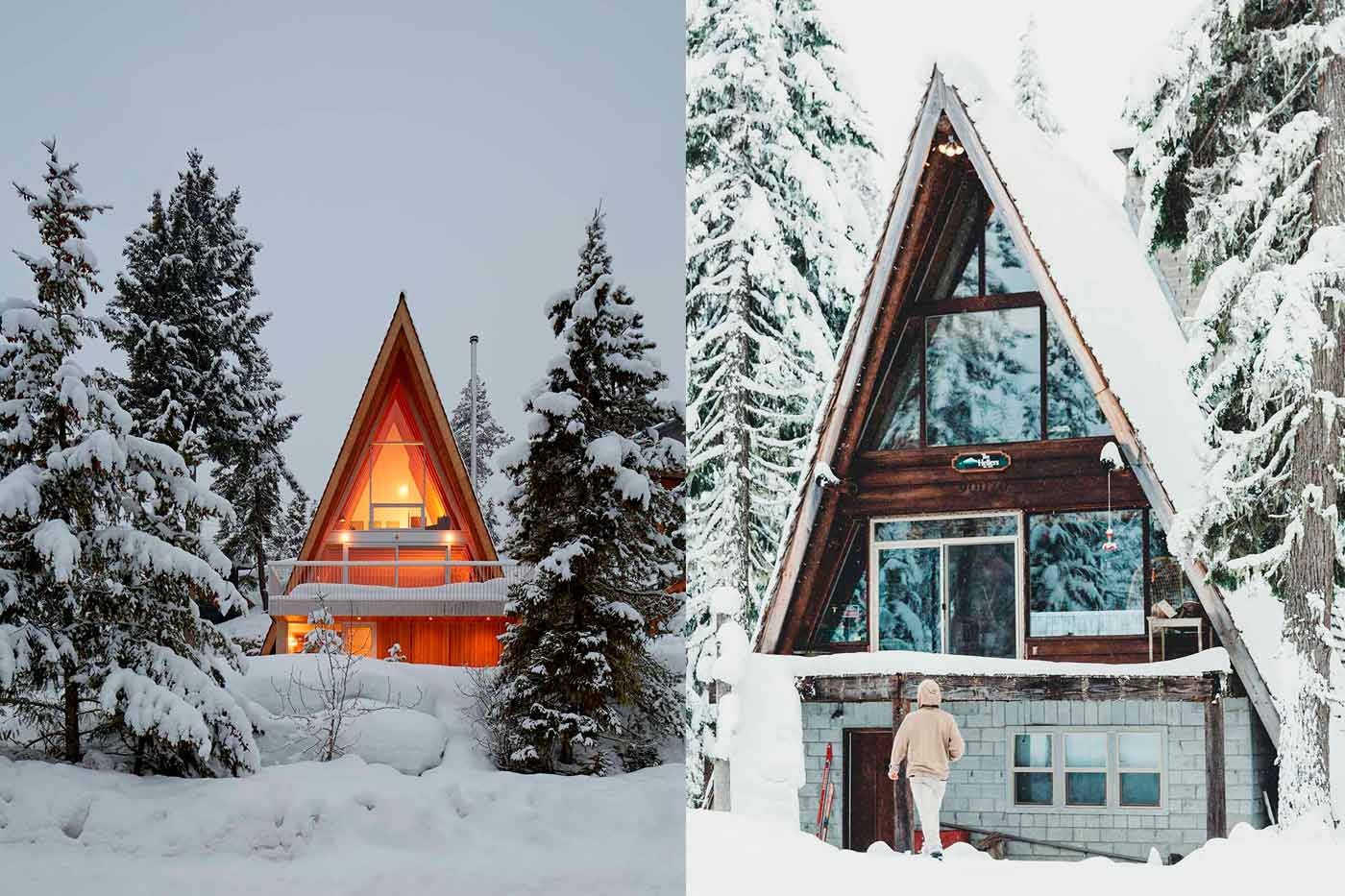
Naturally, Derek has built his share of A-frames, too including one in Albany, Vermont–his own “Arrowhead.”
– “The mini A-frame in Vermont was really born out of thrift. I had an abundance of leftover and salvaged building materials, and I wanted to build a tiny ‘glamping cabin,’ or a mere sleep pod. After surveying what I had, I thought that an A-frame would be feasible and simple, and look rather cool out in the middle of a pine grove on my property.”
Chad Randl and the Birth of the Shape
The A-frame and the triangle were shapes that ushered in the modernist era, but this kind of building actually goes back thousands of years. It was initially used for shelters, but storage buildings, stables, and shrines were also built with this outline.
In his book A-frame (Princeton Architectural Press), Chad Randl gives an account of the history of A-shaped buildings, from pre-historic Japan until the 50s and 60s in the US. According to Randl, it’s unsurprising that this simple construction is so prevalent in early civilizations, from Japanese Tenchi-Kongen buildings to straw-roofed stilt houses and Scandinavian houses with pitched roofs. The common denominator throughout is lines of poles, meeting at an angle, and a protective layer that serves as roof and walls in one.
The earliest triangular houses were built from whatever materials where available. Randl calls it an ‘intuitive’ design–and why else would cultures from all the corners of the world be united by the use of this particular, universal building style?
However, all trends are transient; it is an integral aspect of the very concept. After more than two decades of popularity, the A-frame began to fall out of favor in the mid-70s. It didn’t seem cool or innovative any more. When fast-food and supermarket franchises had appropriated the shape for use in their marketing, its sheen and unique flavor soon faded. It’s rather ironic that the A-frame, which had always represented the dream of family life, lost its attraction once it also became a toy for children, and thus truly attainable for all. Paradoxically enough, when Fischer-Price introduced their A-frame shaped doll’s house in 1974 (it was only in production for two years), this signaled the beginning of the end for the popularity of the style.
A no longer stood for ‘Avant garde’. A-frames had become a mainstream mass consumer item. The energy crisis didn’t help, either. For one thing, it became more expensive to get to the remote locations where many A-frames had been built, and for another, the early A-frames were notoriously difficult to heat in winter and keep cool in summer.

A New Era: the Resurrection of the A-frame
Design styles fall in and out of fashion. They are the -product of various forces and elements of the zeitgeist. And then, they disappear. It happens almost undetectably at first, when an idea shifts from being something exciting and fresh to being old hat. As it becomes more common, and eventually becomes a standard that -other ideas are measured by, its earliest proponents tend to abandon it. After a while, it becomes ripe for resurrection, and is reinterpreted by a new generation.
Towards the end of the 1990s, interest in the A-frames was renewed. There had been a general reawakening of interest in the mid-century era, and its modernist ideas.
In his book, Chad Randl provides blueprints for constructing your own A-frame, and the DIY aspect is particularly significant for the new A-frame movement.
Today’s A-frames are often celebrations of their iconic predecessors, which saw the light of day in the 50s and 60s. They are constructed in general accordance with the original design, but the ambition is always to update them in terms of materials and functionality, and thereby render this style of building more suitable for our times.
Towards the end of the 1990s, interest in the A-frames was renewed. There had been a general reawakening of interest in the mid-century era, and its modernist ideas.
Then and now, the A-frame hovers just over the wilderness, barely detectible, a vantage point for comfortable explorations of nature. The large, nature-facing windows are similar to large projector or TV screens.
– “One great advantage is the light. A-frames tend to feel very open, almost like sitting on a porch or balcony. And then, there are the angles… Another advantage is that you don’t need to shovel any snow off the roof. And since most of the exterior is roof, you don’t need to do much painting, either… One disadvantage is that the walls can make them a bit tricky to furnish,” Hjalmar Hedman explains.
But the open floor plan, which doesn’t provide any hiding places, also serves as a shortcut to interaction. You can’t lurk behind your computer screen in an A-frame, there’s nowhere to go to avoid social interaction. You either spend time with the others, or you go out and spend time with the world outside. A as in Accessible.

-
Subscription
$70.85 -
 Out of stock

