


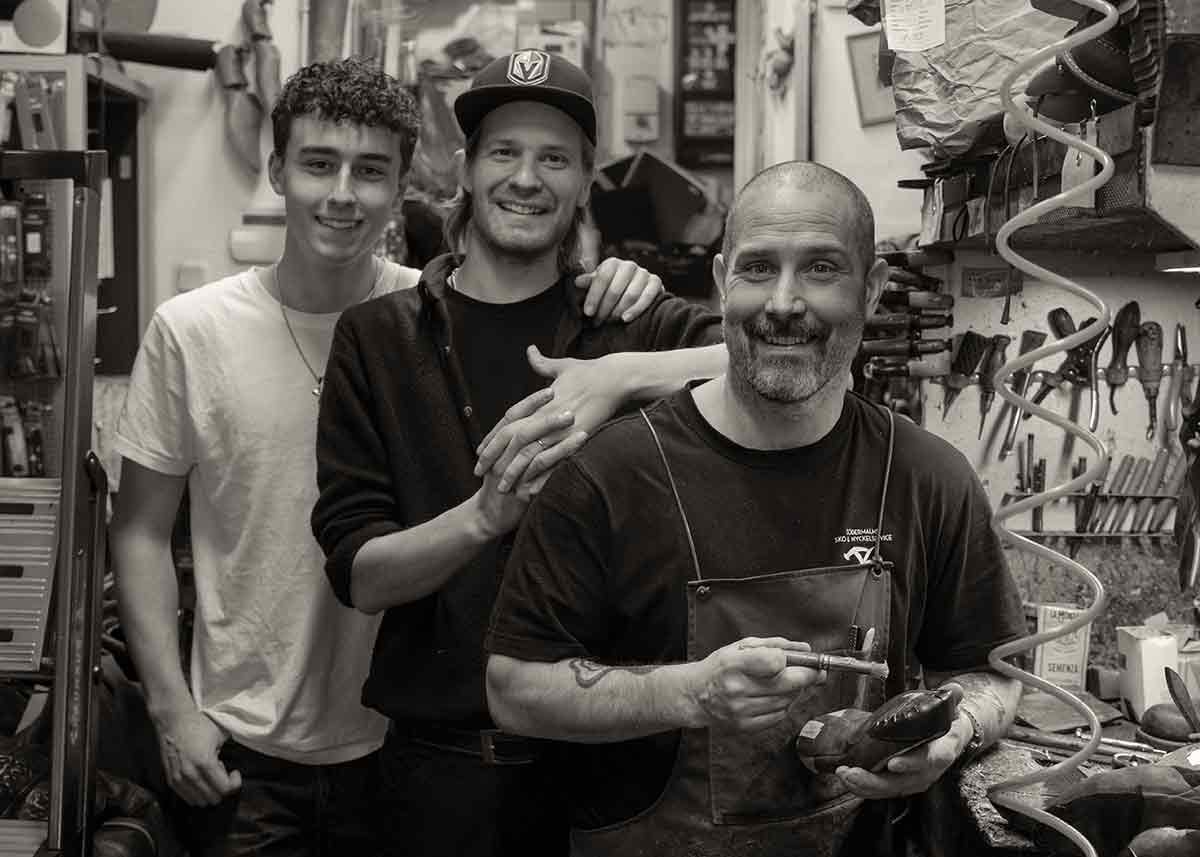

Love is a beautiful thing. Taking care of those you love is of utmost importance when it comes to having a long and beautiful life together. It might be your partner, cat, dog, friends, or family. But you don’t need to walk a mile in my boots to know where my love lies. It’s time to visit Doctor Dennis and Doctor Daniel to talk shoe care.

There’s something special about craftmanship and knowledge, generations in the making. A work of hands. And a love of true artisan craft is special, too. You save up money, decline other temptations to be able to buy that pair of shoes or jeans, the jacket that isn’t necessarily expensive, but is an expense. After this, you wear them every day, too often, really, they wear down but become more beautiful until one day, at last, you realize that you can’t do it anymore. Your darlings need a doctor. They’re a part of you, your personality, your family and now this family member is unwell. But wait! You paid that extra money because they can be repaired or upgraded. You bought an insurance of sorts, insured in knowhow and craftsmanship.
First off, you need to be a loser, that’s the most important thing,” he says succinctly. “Start by having no future plans. That’s a good start.
We open the door to Södermalms Sko och Nyckelservice (Södermalm Shoe and Key Service) – at Folk-ungagatan 102 in Stockholm, a tiny shoe repair shop. How Dennis, a second-generation cobbler, has managed to squeeze in two armchairs next to an old sewing machine for shoes, plus an extra cobbler and a ton of shoes, is a mystery. He and his colleague Daniel fit behind the counter in a shop of maybe 20 square meters (barely over 200 square feet). The ceiling is covered in shoes waiting to be picked up, things are piled everywhere. Shoes in various stages of repair, a ladder (!) and a gigantic shoemaking machine where Daniel is currently smoothing the sole of a pair of well-trodden Iron Rangers. It’s a show of creative solutions. Dennis and Daniel move comfortably around the tight space without bumping into each other once. It’s like watching the ballet.


The fact that Daniel is working on a pair of Red Wing boots is no coincidence. Theirs is the only Red Wing-authorized shoe repair shop in Stockholm. The flagship store in central Stockholm sends bagfuls of boots to be repaired, upgraded, or resoled. But people also seek them out directly – it’s as though everyone knows that Södermalm is the place to get your boots fixed properly.
“To become an authorized Red Wing repair shop,” he says, “you have to send samples to the factory in Minnesota. A guy working in heritage fashion recommended us, and the people at the factory liked what they saw. We’re the only authorized cobbler in Stockholm, even though there are others who could do the work.” Talking about the process, his voice is tinged with pride.
We had another customer, a sign painter who’s been working in his Red Wings for over twenty years. We’ve repaired them so many times, patchwork solution upon patchwork solution so that it barely has a single original part left, but he refuses to let them go.
Dennis explains that every Red Wing store has to have an authorized repair shop tied to them. Customers leave their boots at the store; they send them to the cobbler, who repairs or upgrades the boots before sending them back to the store. Quite a few boots come their way each week.

Around the world in a pair of boots
“If you buy a pair of Red Wings, they can pretty much always be fixed. Rolf Porseryd, famed international reporter, brought in his 1974 Red Wings. Those boots had been around the world several times over. He told us what they’d seen – Sahara, Russia, Africa, war zones! He had some good stories, Porseryd. So that feels really valuable, taking care of a pair like that. It was still worth repairing them. He’d taken good care of them. The leather had cracked, but we fixed it with a leather patch on the inside,” Dennis continues.
“We had another customer, a sign painter who’s been working in his Red Wings for over twenty years. We’ve repaired them so many times, patchwork solution upon patchwork solution so that it barely has a single original part left, but he refuses to let them go.”
Each pair of boots seems to have its own story, often regaled to the cobblers by their owners. It’s a treat to listen to Dennis while he brings out different shoes, shows them and explains.


The quality of real boots
Red Wing boots are sewn, whereas glued shoes tend to crack and are hard to repair. Whether or not a shoe can be repaired often comes down to the outsole and the welt. The welt is what everything is stitched to. “It’s sewn by hand, and it can be tricky,” Dennis says, explaining how the shoe is assembled through the outsole, welt, and upper.
“Some people bring in their Red Wings and say, ‘I love these boots, I’ve had them since 1970’.” We can do almost anything, but at some point, it gets really expensive. That’s usually where you hit a breaking point, when it’s more expensive to fix the shoe than to buy a new pair. But people love their boots like they love their kids, their dogs. They have to be saved. The mistake most people make is wearing their boots too much. They retain moisture and don’t get the chance to dry out between wears. This makes them sort of shrivel up and lose their shape. I don’t know if you want to put your hand in there,” Dennis says, presenting a pair of thoroughly worn but gorgeous Iron Rangers. “If you feel the front, you can tell that it’s sort of lost its shape. But the customer wanted us to fix it anyway. This one is borderline – it’ll end up costing the same as a whole new shoe.”
Brush them and condition them if needed, but not too often. Apply a thin layer, let it absorb, then wipe off anything that’s left over. You can check if they need treatment by brushing them first. If they look matte, it might be time to add some conditioning.
He continues, “The typical thing to do is replace the white sole. That’s everything up to the welt. There’s a cork layer in between, we replace that too.” He brings out a tin of sticky cork mixture, which he spreads out the same way you’d spread a thick mustard on bread. The next step is for it to dry.
A customer enters the store and shows them a pair of moc toes. They sole is not completely worn thin, but they’re getting slippery, he says.
“Sure,” says Dennis. “They’re not too bad, but we usually recommend replacing the whole bottom, 180 bucks, that means everything is new and you can walk as much as you want.”
“Let’s do it, I love these shoes!”
The place has the air of a vinyl record shop. Chatting with customers, their enthusiasm and love for their boots is fascinating. The nerd factor is high. It’s interesting to see how something you’ve bought – or invested in, rather – means so much to the owners.

Boot Camp
The conversation moves on to shoe trees, and common mistakes that people make in caring for their shoes. It’s one aha-moment after another, hearing Dennis’s and Daniel’s insight. I almost feel ashamed over how terribly I treat my own shoes and boots. Now that I understand how much work goes into making a pair of shoes, I promise myself that in the future I’ll take better care of mine.
“Some people buy nice shoes but only put them in shoe trees to store them for winter. That won’t help much. Shoe trees are meant to be used when you’ve just worn the shoes, when they’re a little moist. If it’s wet out and the shoes are wet, put the trees in overnight. Then you can take them out. The shoe will fare much better, the leather won’t shrink, and you can avoid cracks. They get their shape back. It doesn’t hurt to have shoe trees in your shoes over winter, but it doesn’t do much good either. The ideal material is North American cedar. Cedar kills bacteria, too. The absolute cream of the crop is red cedar but it’s terribly expensive. A lot of people who buy a pair of Red Wings don’t know how to care for them. People often get the advice to condition with wax or oil frequently. But 90% of boots we got in the last few years were actually over-treated. It rots the skin.”


So how should one care for the boots?
“Brush them and condition them if needed, but not too often. Apply a thin layer, let it absorb, then wipe off anything that’s left over. You can check if they need treatment by brushing them first. If they look matte, it might be time to add some conditioning.
Young people are better at looking after their things. People born in the late 60s are the worst. They think they’re the best, they’ve done their compulsory military service so they know how to shine shoes, yada yada, but they’re actually the worst!” he says with a laugh.
It’s like a club for people who like quality. A hobby, even a lifestyle, you buy good clothes and shoes instead of playing golf. You learn to take care of the pieces, so they last longer.
Cobbler School
I ask Daniel what it takes to become a good cobbler.
“First off, you need to be a loser, that’s the most important thing,” he says succinctly. “Start by having no future plans. That’s a good start.”
He continues, “You need to be handy and curious and not afraid of messing up. A lot of the work is repetitive, but sometimes we’ll get a brand-new material that we’ve never seen before. Then it’s trial and error. You think you’ve done it all, but you haven’t. The basics are pretty easy to learn, but you’ll never fully master all the details.”

Dennis laughs and jumps in, “You can’t be all thumbs. Either you’ve got it or you don’t. You can tell pretty quickly if it’ll work or not simply by handing someone a hammer.”
Daniel started in 2016 with a job at a shoe repair store. He started out as an apprentice but was allowed to work independently early on.
“I never got my journeyman’s certification, though, but I think I’m just lazy,” he laughs.
Dennis explains that you enter the profession with a 3-year apprenticeship, after which you can be licensed as a journeyman.
“He’s really good, even though it’s hard to believe,” Dennis says, laughing. There’s an air of appreciation and respect in the store.
He continues, “It’s so nice. We’ve worked together for so long that all we have to do is pass a shoe to the other and he’ll know just what the next step is, without a bunch of instructions,” Dennis says.
Besides the two of them, Dennis’s dad fills in sometimes, as well as Dennis’s son, who is 17.
“He says he’s not planning on becoming a cobbler, just like I said. But I actually don’t think he will. My daughter, on the other hand, she could be, she is nimble and handy.”


Never a cobbler
Dennis says he never intended to be a cobbler like his father. He worked as a carpenter and played ice hockey.
“I was supposed to start school but had terrible grades. Only one thing was certain: I wouldn’t end up a cobbler like my dad. I needed to get my grades up to go to college. This was like 20 years ago. Dad asked if I could work here while I was figuring out what to do, and now here we are,” he says, chuckling. “Dad’s on his 52nd year as a cobbler and is the longest-active, now-living cobbler in Sweden.”

Events
Dennis says they often host events at the Red Wing store.
“Working the events is fun, meeting people who share our interests,” he says.
I ask if he can change my moc toe white soles to something thicker.


“Absolutely,” he says. “That’s the good thing about these boots, we make loads of custom adjustments. It’ll cost you, but you get exactly what you want. I have a pair of Iron Rangers where I’ve added a leather sole and a higher heel with a slight curve. The only thing we can’t do is change a Super Sole. That requires a special machine that we don’t have.


“There’s more to making a shoe than you think. When we get bags full of shoes from the Red Wing store, we have to pick out stitches for ages. We had a peak time of two bags a week, about 15 pairs each. That was pretty stressful. I brought a bag home, and my wife and I sat on the couch, picking. These little thread pieces were scattered all over the apartment. But it’s a good problem to have.”
Dennis shows me how to put on a new sole, filling it with new cork paste from a jar. Then the boots need to dry overnight.
This morning has been a crash course. Now I’m itching for what’s next. Changing the soles of my moc toes feels like my next big investment.

Follow the guys on Instagram here!


-
Subscription
$70.85 -
 Out of stock

